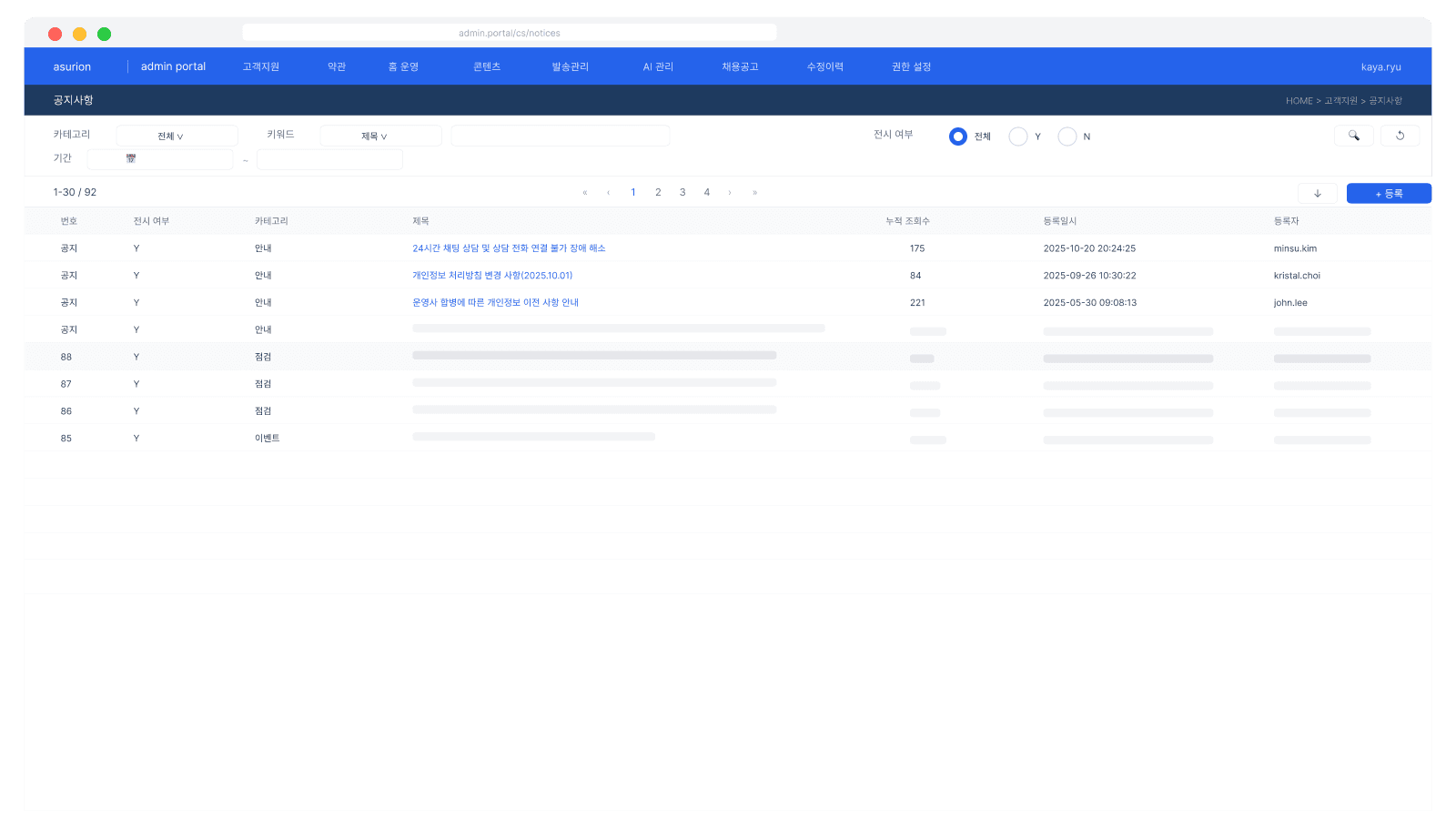
 Mock Image
01 — Context
Summary
This project changed a workflow where even a simple announcement required an IT request and a deployment cycle. Built to give business teams direct control over their content — and architected so well from the start that it went on to run two more services years later without any structural changes.
02 — Challenge
Problem
Non-technical teams — Marketing, HR, Security — had no way to update content on their own. Even a single popup line, announcement, or terms change had to go through an IT request and wait its turn in the deployment queue, which made everything slow. The scope also kept growing well past the original plan, so the architecture needed to stay flexible enough to absorb whatever came next.
03 — Approach
What I Did
- Designed a modular architecture from day one so scope could keep expanding without structural rework. What started as 4 main menus and 10 sub-menus has grown to 9 main menus and 26 sub-menus.
- Extracted recurring elements — CKEditor, image upload, form components — into shared components, so scope growth meant expanding variants rather than building from scratch each time.
- Prioritized an intuitive, minimal UX, since this was an admin tool built for non-technical operators.
- The 1920px min-width was originally fixed by the planner, but after seeing colleagues struggle with the portal on laptops during remote work and meetings, I proposed and built a 1280px responsive layout instead. Feedback afterward: "So much easier to use on a laptop."
04 — Outcome
Result
Multiple business teams — Security, Marketing, SCM, HR, AI Operations — gained the ability to manage content independently, without IT involvement or deployment cycles. The architecture, originally scoped for the SKT Portal, was later adopted for two more services with no structural changes required — one architecture now running three production platforms.